
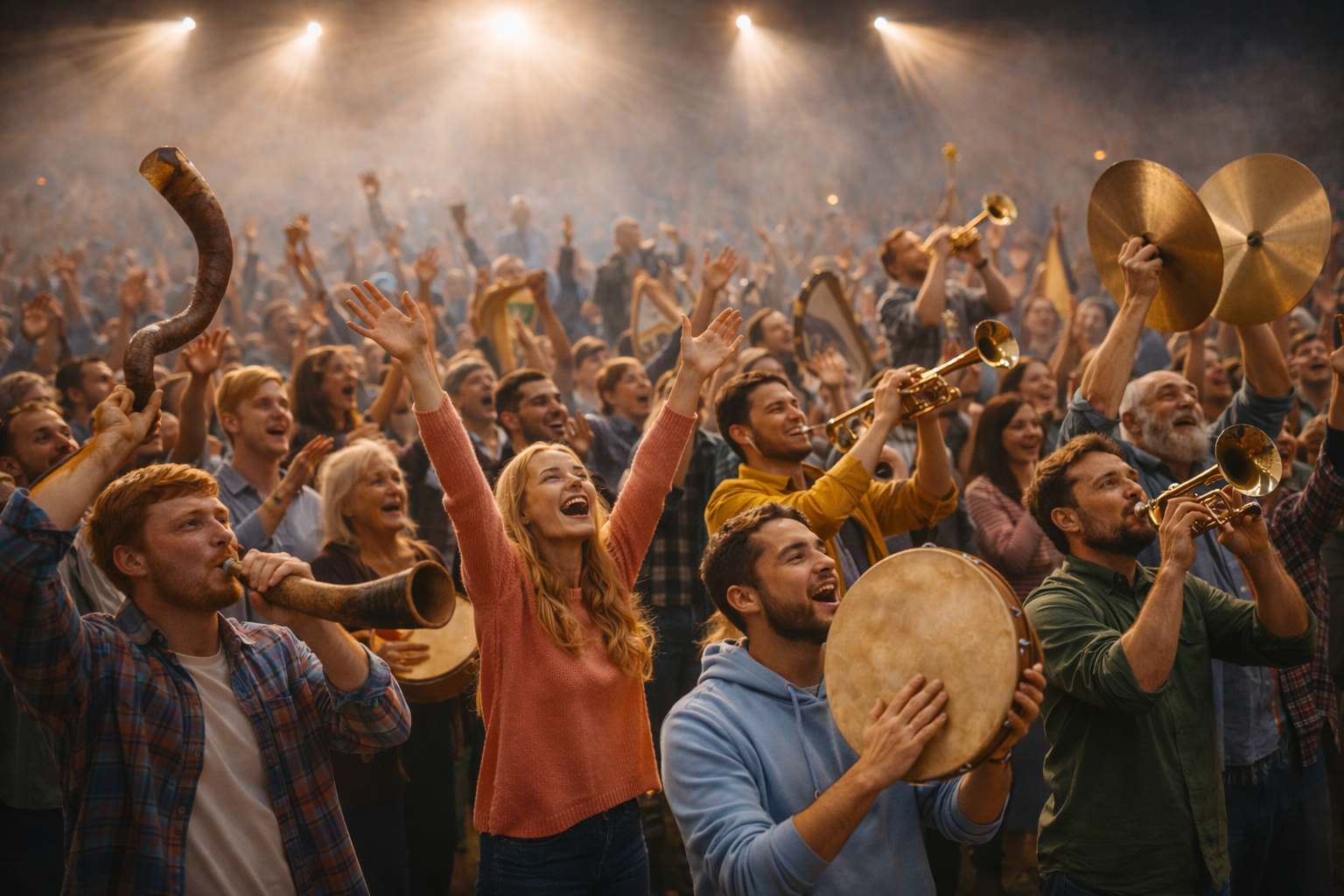
Join us for A National Festal Shout of victory over our land— Saturday 23 May 2026
A Proposal
It is pretty obvious that we are living in uncertain and even dangerous times. We are threatened by the prospect of widening war. Arguably, it is due to the worldly values, beliefs, attitudes and choices of human beings. From a Christian point of view there is good reason to believe that “the prince of this world” (Jn 14:30) is manipulating events by means of the largely unwitting cooperation of human beings.
Needless to say, the prophetic signs of the times call for a multi-faceted response by believers, e.g., by means of repentance, intercession, evangelisation and spiritual warfare. As St Paul said, “For our struggle is not against flesh and blood, but against the rulers, against the authorities, against the powers of this dark world and against the spiritual forces of evil in the heavenly realms,” (Eph 6:12), and that, “The weapons we fight with are not the weapons of the world. On the contrary, they have divine power to demolish strongholds.” One way of doing this is to rely on the festal shout of victory in order to declare Christ’s victory over the powers of evil at work in our world.
The members of The New Springtime Community in Dublin and Cork, are inviting Protestant and Catholic believers, including the members The Army of Praise to gather in Emmanuel House, on the eve of Pentecost the 23rd May. There we intend to declare in high praises, both in English and the gift of praying and singing in tongues, that Jesus as the light of the world will be triumphant over the powers of darkness at work within it. We will have more to say about our plans in the coming weeks. In the meantime, we can pray with Pope Francis, “Holy Trinity, Almighty God, Blood of Christ, destroy the devil, disable and paralyze the traps of those who are manipulating the whole world.”
The New Springtime Community, have revised a booklet entitled, The Festal Shout of Victory Over Cities, Towns & Localities which was originally published in 2017. It is available for free download from this website. A word about the booklet. Firstly, it has an introduction which explains how and why we came to espouse the notion of festal shouts of victory. Secondly, it includes a biblical exploration of this neglected aspect of spiritual warfare in the Old and New Testaments. Thirdly, it concludes with practical guidance about how to run a festal shout of victory event. Fr. Pat Collins, C.M.
National Festal Shout of Victory over Our Land
*
National Festal Shout of Victory over Our Land *
A festal shout is a powerful, joyful cry of praise and victory raised to God by His people, celebrating His triumphs, faithfulness, and presence, often during sacred feasts or battles against evil. This shout was not just noise—it was a public declaration that God is King, that He has overcome darkness, and that His people stand secure in His covenant love. In moments of battle, worship, or celebration, Israel would raise this cry as a sign of confidence in the Lord’s saving power.
We see this powerfully in Joshua 6, when the Israelites lifted a great shout at God’s command and the walls of Jericho collapsed — a sign that the Lord Himself overthrows every stronghold of darkness.
We now invite you to join us for a National Festal Shout of Victory over our land on Saturday, 23 May 2026 when we will gather outdoors on the grounds of Emmanuel House of Providence in Clonfert, Co. Galway, to echo this united proclamation once more — declaring Christ’s victory and welcoming the renewing fire of the Holy Spirit over Ireland today.
To deepen our understanding of the Festal Shout and to prepare our hearts for what the Lord desires to do among us, we turn to a powerful scriptural meditation offered by Fr Pat Collins, C.M. Drawing from Nehemiah chapters 2–4. Fr Pat reflects on how God rebuilds what is broken, strengthens His people in times of opposition, and leads them into victory through faith, prayer, praise, and steadfast trust.
Nehemiah and the Re-building of the Broken Walls of Jerusalem Nehemiah ch: 2-4
In the early nineteen eighties I was living in Boston, in the U.S.A. One morning I received a mysterious word of prophecy as I travelled by train to College. It has influenced me ever since. Although I didn’t understand it fully at the time, I was able to remember it and wrote it down sometime afterwards. It went as follows.
“Leave the city with its proud flags and go to the breach in the wall.
Go and stand in the breach, the place of insecurity.
Stand in the breach where the wind blows, where the jackal cries
and where the enemy enters under the cloak of darkness.
Stand in the breach, and intercede for yourself and for my people.
Stand in the breach and listen to my word.
Then call my people to the breach to rebuild the walls of Jerusalem.”
Because I was anxious to discern whether these words were inspired or not, I opted to do something that I have often advised others not to do. I decided that I would cut the scriptures with my eyes shut. Then I would put my finger on one of the open pages. If it was on the words, “Rebuild the walls of Jerusalem,” I would presume that the word of prophecy had come from the Lord and not from myself or the evil one. After a brief prayer for help, I opened the bible at random and placed my finger on the page. It was resting on Ps. 51:58, which reads, “Rebuild the walls of Jerusalem!” On two memorable occasions I was led to read chapters two to four of the Book of Nehemiah for guidance
Together, chapters 2–4 of the Book of Nehemiah show a pattern that recurs throughout the prophet’s writing:
• A God‑given vision (Ch. 2)
• A community mobilized (Ch. 3)
• Opposition met with steadfastness (Ch. 4)
They form the narrative arc of any genuine work of restoration—discernment, cooperation, and perseverance.
Nehemiah was a model leader
Nehemiah was a remarkable leader for a number of reasons. Firstly, he was a man of passion. Although he had never been in Jerusalem, he was deeply disturbed when he heard that the holy city was depopulated, its walls had been breached and its gates destroyed (cf. Neh 1:2-3). This awareness evoked within him a strong desire to do something practical about the situation. Secondly, he was a man of vision. Following a time of prayer, he had a divinely inspired plan for the restoration of the city (cf., Neh 1:4-10). That is an important point. As Prov 29:18 says, “Where there is no prophetic vision, the people perish.” Thirdly, he was a man of action. Having received permission from King Artaxerxes I to implement his plan to repair the walls of Jerusalem (cf. Neh 2:5) he made a discreet survey of the city to see exactly what would be needed (cf. Neh 2:11-16) and recruited many people to help him. The contemporary Church desperately needs leaders like Nehemiah, men and women of passion, and practicality. But most of all they need a vision of a renewed Church, not a vision that is based on purely human thinking but one which is inspired by the Holy Spirit. As the Psalmist warned, “Unless the Lord builds the house, those who build it labour in vain” (Ps 127:1). Sad to say, currently there seem to be very few leaders who have an inspiring vision of what the Church of the future might be like.
The breaches in the walls
Nehemiah described how the Jewish volunteers went to the breaches in the walls of Jerusalem in order to begin the work of restoration. They said to one another, "Let us start rebuilding." So they began this good work.” Nehemiah reassured them saying, “The God of heaven will give us success” (Neh 2:18; 20). The breaches in the walls of Jerusalem are symbolic of the places where the present day Church is weak and vulnerable. Sadly, we are all too painfully aware that the walls of the Irish Church have been badly damaged by sinful abuse and subsequent cover-ups that came to light in the Savi, Ferns, Ryan and Murphy reports. As a result, five bishops have had to resign and the Church has had to pay out hundreds of millions of euros in compensation. In an article entitled, “The Murphy Report One Year Later,” Archbishop Diarmuid Martin said in a realistic and insightful way, “As I look back . . . I see more clearly that the catastrophic manner in which the abuse was dealt with was a symptom of a deeper malaise within the Irish Church [my italics].”
Resist the enemy firm in faith
Nehemiah was conscious of the danger of attack by enemies. In Neh 4:7-8 we are told that, “When Sanballat, Tobiah, the Arabs, the Ammonites and the men of Ashdod heard that the repairs to Jerusalem's walls had gone ahead and that the gaps were being closed, they were very angry. They all plotted together to come and fight against Jerusalem and stir up trouble against it.” Those who opposed the rebuilding of Jerusalem are symbolic of the opposition of the devil and his demons. As St. Paul said in Eph 6:12 “our struggle is not against flesh and blood, but against the rulers, against the authorities, against the powers of this dark world and against the spiritual forces of evil in the heavenly realms.” Pope St Paul VI was well aware of the assaults of the devil on the Church. In 1972 he gave a long talk on the devil, in the course of which he said, “We must fight against the demon. We do not think about this reality anymore, but I now wish to draw your attention to this terrible and unavoidable subject. We must fight against this enemy, terrible and invisible, who sets snares for our life and against whom we must defend ourselves.” When he was here in Ireland in 1979, Pope John Paul II warned us about the likelihood of demonic attack when he said in Limerick, “Satan, the tempter, the adversary of Christ, will use all his might and all his deceptions to win Ireland for the way of the world.” In many ways the prince of this world (cf. Jn 12:31) has already succeeded in leading many people away from fidelity to Christ.
Getting rid of the rubble in our lives
Nehemiah tells us that there was a great deal of rubble lying outside the walls. In Neh 4:11-12, we read, “Meanwhile, the people in Judah said, "The strength of the labourers is giving out, and there is so much rubble that we cannot rebuild the wall." Also, our enemies said, "Before they know it or see us, we will be right there among them and will kill them and put an end to the work." Evidently, the enemies used the rubble as cover. They hid behind it, in readiness to make sneak attacks. From a symbolic point of view, the rubble represents the worldly and sinful attachments in our lives, such as an inordinate desire for things such as possessions, position, popularity, pleasure, and power, which the evil one can exploit in order to mount attacks on a vulnerable Church. We need to rid ourselves of worldly attachments which nail down our spiritual energy to created things in an idolatrous way (cf . Phil 3:19). We need to progressively rid ourselves of rubbish of this kind by means of on-going conversion and sensible acts of self-denial such as fasting.
We know that the members of the New Testament Church fasted regularly. It served a number of purposes, to make satisfaction for sin; control bodily passions; experience solidarity with the poor; and express, in a symbolic way, a creaturely dependence on God. In the Acts of the Apostles, we are told that the believers sometimes received divine guidance following periods of prayer and fasting (Cf. Acts 13:2; 14:23). The Didache, which was written in 70 A.D. before the fall of Jerusalem, urged Christians to fast on Wednesdays and Fridays. Although the Lenten fast is no longer compulsory, surely Christians would do well to engage in sensible abstinence, for specified periods of time, during the year. Others fast during the liturgical seasons of Lent and Advent.
Intercessors and spiritual combat
Because Nehemiah was so conscious of the danger of attack, he decided to protect the city by appointing half the people to guard it and its citizens. They had the task of noticing when and where their enemies intended to attack. In Neh 4:14-15, we read, “Therefore I stationed some of the people behind the lowest points of the wall at the exposed places, posting them by families, with their swords, spears and bows. After I looked things over, I stood up and said to the nobles, the officials and the rest of the people, "Don't be afraid of them. Remember the Lord, who is great and awesome, and fight for your brothers, your sons and your daughters, your wives and your homes." These guardians represent the role of intercessors who engage in spiritual warfare and combat. As St. Paul said in 2 Cor 10:4-5, “We do not wage war as the world does. The weapons we fight with are not the weapons of the world. On the contrary, they have divine power to demolish strongholds. We demolish arguments and every pretension that sets itself up against the knowledge of God, and we take captive every thought to make it obedient to Christ.” In Eph 6:11, having said, “Put on the full armour of God so that you can take your stand against the devil's schemes,”
In the light of these scripture texts, it is significant that Pope John Paul II said in Limerick in 1979, “Dear sons and daughters of Ireland, pray, pray not to be led into temptation . . . I ask you today for a great, intense and growing prayer for all the people of Ireland, for the Church in Ireland, for all the Church which owes so much to Ireland. Pray that Ireland will not fail in the test. Pray as Jesus has taught us to pray: Lead us not into temptation.”
Praise and the affirmation of deliverance
Nehemiah tells us that as part of the defence of the city and the workers, he appointed a trumpet player to sound the alarm during times of danger or attack. In Neh 4:19-20 we read, “Then I said to the nobles, the officials and the rest of the people, "The work is extensive and spread out, and we are widely separated from each other along the wall. Wherever you hear the sound of the trumpet, join us there." The trumpet symbolizes the importance of praising God as an integral aspect of spiritual warfare. Ps 22:3 assures us that God lives in the praises of his people. He is greater than the enemy we face. As we nestle in his protection by means of faith-filled praise, he does battle with the evil one on our behalf. In a number of places in the Old Testament we are told that the musicians guided Jewish armies into battle (cf. 2 Chron 20:21; Josh 6:8). They led the triumphant praises of the people who affirmed the fact that the Lord would be fighting for them and that victory, therefore, was assured. As Nehemiah testified, “Our God will fight for us!" (Neh 4:19). In 2 Chron 19:15 here is a similar expression of confidence. “This is what the Lord says to you: 'Do not be afraid or discouraged because of this vast army. For the battle is not yours, but God's.” Those who want to re-build the Church should engage in praise that is loud and long and culminating in the festal shout of victory.
Re-building as the new evangelisation
In chapter three Nehemiah describes how different family groups volunteered to help with the re-building of the many breaches in the walls of Jerusalem. In contemporary terms the builders are symbolic of the men and women who are responding to the Church’s repeated calls to engage in what Popes Paul VI, John Paul II, Benedict XVI and Francis have referred to as the new evangelisation.
“Come into his presence with songs of joy!”
Ps 100 (99): 2